Skip to content

Platform / Procurement Agents

Inventory to invoice, end to end.

The loop starts when an inventory level dips or a demand signal lands. Agents source the vendors, send the RFQs, parse the quotes, negotiate the terms, write the PO into your ERP, then match the invoice and the goods receipt when they arrive. You handle the calls in the middle that need a human.

agent ops · live

refresh 1s

Emailrunning

Parsing supplier@steelcore

47/h

Classifyrunning

Routing 3 new RFQs

184/h

Extractrunning

Quote → structured · 12

92/h

Negotiaterunning

Counter on PO-2847

28/h

Matchok

INV-9201 ↔ PO-2841 ✓

146/h

POrunning

Writing PO-2847 to SAP

31/h

Complyok

Sanctions check · 4 pass

61/h

Scorerunning

Updating vendor scorecard

Knowledgeidle

Indexing Q1 negotiation log

1,184 actions · last hour · 3 awaiting your approval

view all →

A real flow

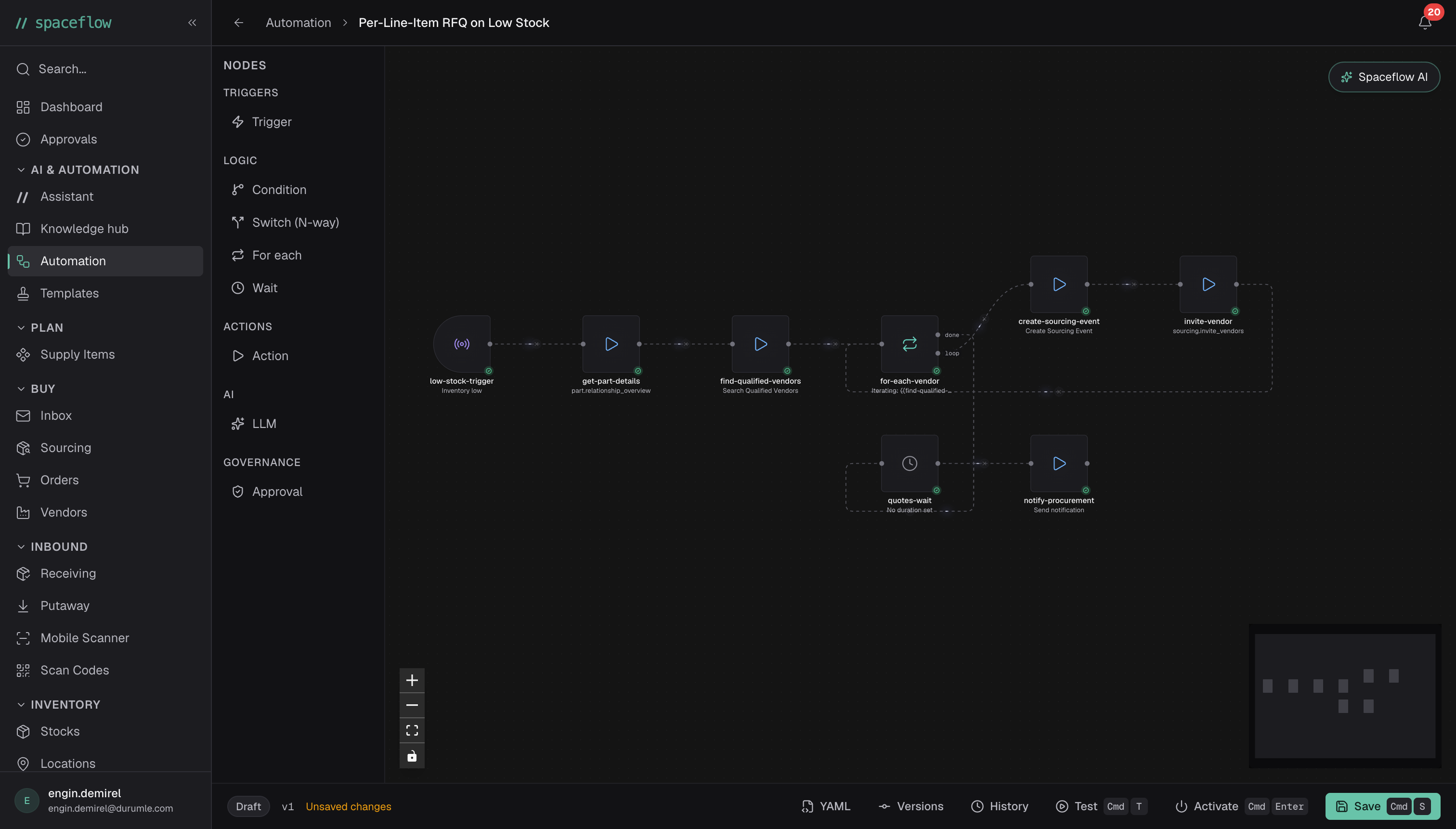
Per-line-item RFQ, the moment stock dips.

One of the workflows your team can compose, edit, and version inside Spaceflow. Triggers, logic, actions, LLM calls, and human approval all live on the same canvas. When the agent fires, every node it touched is recoverable from the audit log.

Spaceflow Automation builder showing a Per-Line-Item RFQ on Low Stock workflow: trigger → get part details → find qualified vendors → for each vendor → create sourcing event and invite vendor → quotes wait → notify procurement.

scroll →

What this replaces

Procurement is end to end. Most tools cover one slice.

The loop has nine or ten distinct steps. Inventory signal, vendor selection, RFQ, quote intake, comparison, negotiation, approval, PO, goods receipt, invoice match. The middle 70% is waiting, repeating, and reformatting. The agents close that gap end to end.

The demand signal arrives before anyone is looking

Stockouts

An inventory level dips below the reorder point on a Sunday night. A safety-stock buffer gets eaten on a Tuesday afternoon. The agent reads the signal the moment it happens, pulls the part and supplier history, and starts the sourcing flow before the planner sees the alert on Monday.

Quotes get lost between inbox and spreadsheet

Margin

A supplier sends a quote at 11pm. Someone copies it into a sheet the next morning. Someone else compares it manually. By the time a decision happens, half the responses have aged out and the cheaper option already moved on. Agents read every quote in real time and normalize the comparison.

Negotiation only happens when someone has time

Margin

Counter-offers, follow-ups, last-call asks. The mechanics are well understood. The reason they don't happen consistently is that nobody has the time to do them on every line item. Agents do, within the bands you set.

Invoice match is where the savings leak back out

Audit pain

Even the cleanest sourcing cycle loses margin at the back end when invoices don't match POs and goods receipts. Three-way match runs continuously. Variances flag the moment they happen, route to the right human, and clean ones auto-approve.

The agents, in the order they run.

  1. STOCK

    Watches inventory

    Reads stock levels, demand signals, reorder points, and safety-stock buffers from your ERP and warehouse systems. Fires the loop the moment a threshold trips, ahead of the next planning cycle.

  2. SOURCE

    Picks the right vendors

    Pulls qualified vendors for the part from your master data and the Knowledge Hub. Considers prior performance, current capacity signals, and your approved supplier list.

  3. EMAIL

    Reads and writes mail

    Parses inbound quotes, acknowledgments, lead-time confirmations, and shipping notices. Drafts and sends outbound RFQs and follow-ups under the user's identity.

  4. CLASSIFY

    Sorts intent

    Decides what each inbound message is. New quote, counter-offer, question, complaint. Routes it to the right downstream agent or the right human.

  5. EXTRACT

    Structures the data

    Prices, MOQs, lead times, payment terms, currency. Normalizes them against your master data so comparisons are apples-to-apples.

  6. NEGOTIATE

    Sends counter-offers

    Within bands you set, against historical pricing and current market signals. Tracks responses and escalates when it hits your stop line.

  7. COMPLY

    Runs policy checks

    Sanctions, dual-use, ESG, supplier code-of-conduct. Stops anything that fails before it reaches a buyer.

  8. PO

    Writes the PO

    Creates and amends POs in your ERP. Honors your existing approval chains and release strategies. The buyer just sees the commit they need to make. No form filling.

  9. MATCH

    Closes the loop

    Three-way match between invoice, PO, and goods receipt as records arrive. Auto-approves what's clean, surfaces variances with full context, holds the rest.

  10. SCORE

    Feeds the next cycle

    OTIF, quality returns, response time, dispute rate. Continuously updates the supplier scorecard the Source agent reads from. The loop gets better with every run.

Works with

Connects to where your work already happens.

OutlookGmailSlackTeamsSAPOracleDynamicsExcelSharePointCoupaAriba

In production

Putting Tavuk Dünyası's supply chain on autopilot.

We're joining forces with one of Türkiye's most-loved food brands. The agents are reading inbound supplier email, comparing quotes, and handling the negotiation loop. Excited about what we're going to ship together.

Read more

Put the loop in production.

We'll connect a sandbox of your ERP and your inbox, run the end-to-end loop against last month's real demand signal, and show you where it would have caught what your team missed.